What Childhood Games in Hong Kong Can Teach Us About Life

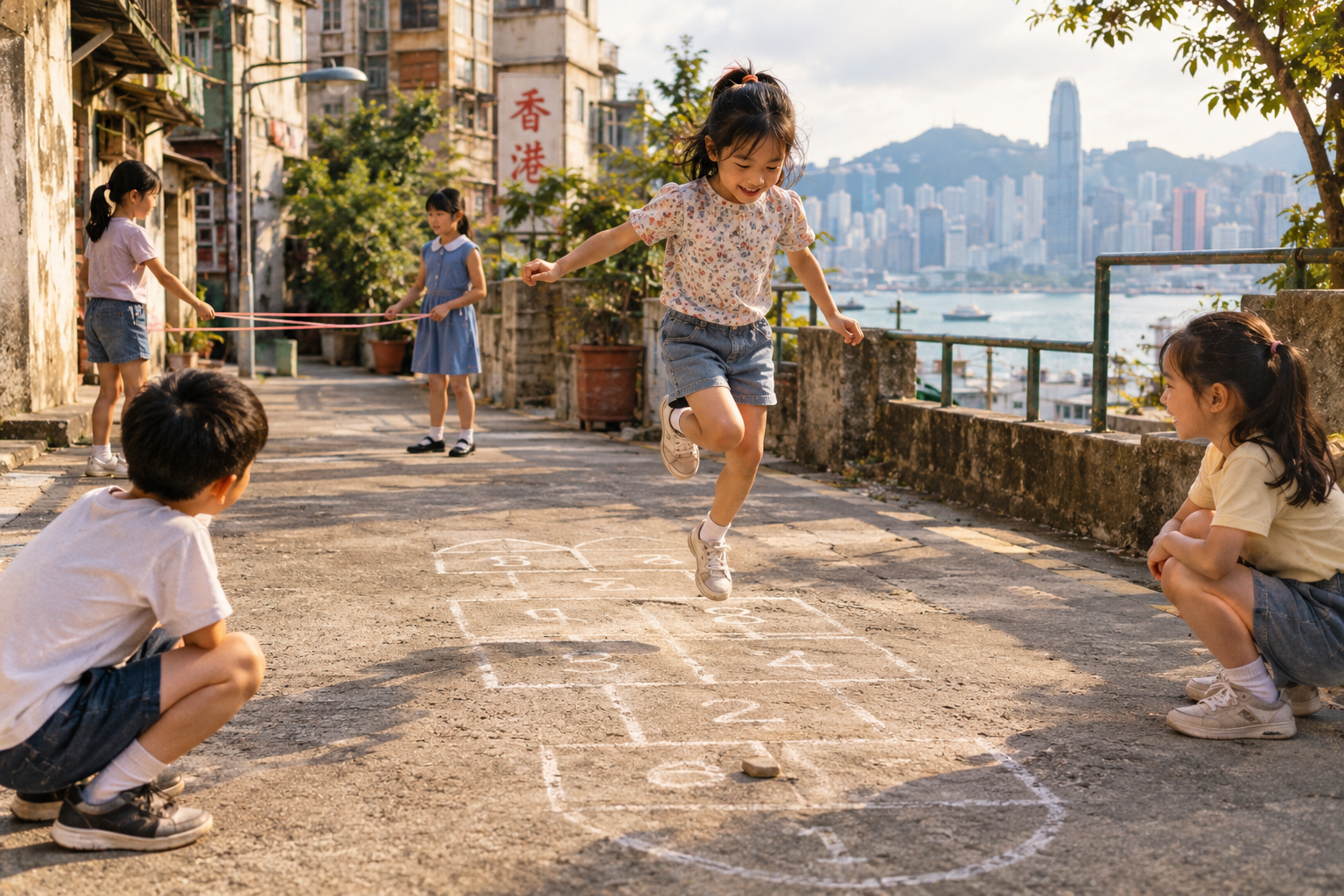
Before smartphones and digital entertainment became part of everyday life, children in Hong Kong found enjoyment in much simpler things. A piece of chalk, a handful of stones, or a long string of rubber bands could turn an ordinary playground or street corner into a place of excitement.
Traditional childhood games were more than ways to pass the time. Without realising it, children were developing skills that would stay with them long after the games ended. From patience and perseverance to creativity and cooperation, these everyday activities offered lessons that remain just as relevant today.
One familiar example is hopscotch, known in Cantonese as tiu fei gei (跳飛機), or "jumping aeroplane". The game required little more than squares drawn on the ground and a small object to throw. Players had to hop through the squares, maintaining their balance while avoiding the lines.
It sounds simple, but anyone watching could see the concentration involved. One misplaced step meant losing a turn, and reaching the end required patience and practice.
There is something valuable in that process. Children learned that mistakes were not necessarily failures, but opportunities to try again. They also discovered that rushing did not always bring better results. Sometimes, slowing down and paying attention was the best way forward.
Another popular game was rubber-band jumping, or tiu gaau gan (跳橡筋). A long chain of rubber bands would be stretched between two players while another attempted to jump over it. As each round progressed, the height increased, making the challenge more difficult.
What makes this game interesting is how naturally it encouraged children to push beyond their comfort zones. Just as they became confident at one level, the next presented a new challenge.
This is an important lesson in learning. Progress rarely happens when we remain comfortable with what we already know. It comes from attempting something slightly more difficult, discovering our limitations, and finding ways to overcome them.
Traditional games also taught children how to interact with one another. Hide-and-seek, or zuk mai cong (捉迷藏), required players to agree on rules, respect boundaries, and take turns.
Disagreements were sometimes inevitable. Someone might argue about whether a hiding place was allowed or whether another player had been caught fairly. Yet resolving these small disputes was part of the experience.
Children learned that getting along with others required patience, fairness, and the willingness to compromise. These lessons could not always be taught through instructions alone. They had to be experienced.
Perhaps one of the most remarkable aspects of these games was how little they required. In a densely populated city like Hong Kong, children often had to make the most of limited space and resources. A pavement could become a hopscotch court, while a few rubber bands could provide an afternoon of entertainment.
Such simplicity encouraged imagination. Children did not necessarily need expensive toys or elaborate equipment to enjoy themselves. They could create opportunities for fun using what was already available.
Of course, childhood has changed considerably. Technology now offers new forms of entertainment and learning that previous generations could scarcely have imagined. There is value in these developments, and it would be unfair to suggest that traditional games were inherently better.
Nevertheless, older games remind us that some of life's most meaningful lessons emerge through ordinary experiences.
A child learning to balance on one foot is also practising patience. A group negotiating the rules of a game is learning fairness. Someone attempting a difficult jump for the fifth time is discovering perseverance.
These moments may appear insignificant, but together they help shape how children approach challenges and understand the world around them.
Perhaps that is what makes traditional childhood games worth remembering. Their greatest value was not simply the enjoyment they brought, but the lessons children could carry with them long after playtime was over.