Marty Sun | Reaching Your Peak With William Louey

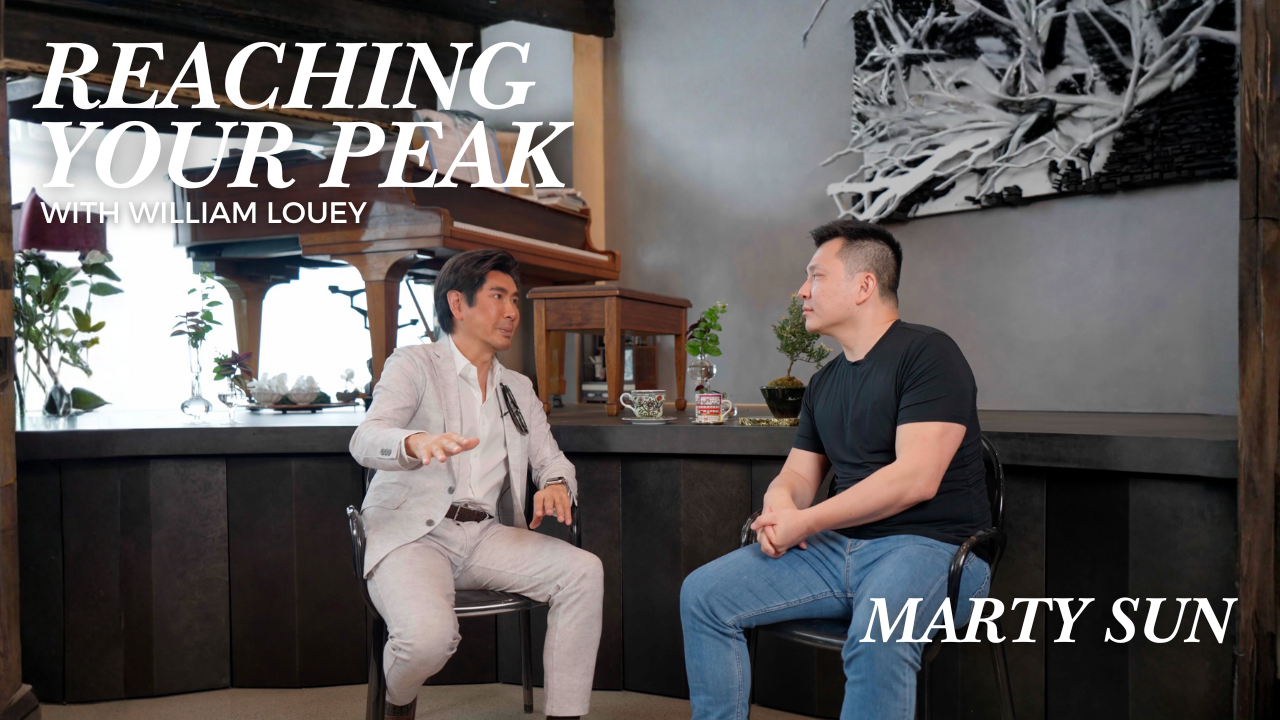
In this episode of Reaching Your Peak with With William Louey, William sits down with one of his early William S.D. Louey Educational Foundation scholars, Marty Sun, for a deeply personal and wide-ranging conversation about success, resilience, and what it truly means to “reach your peak.” Marty, sponsored from 2000 to 2004 and now a seasoned finance professional, reflects on his journey from a modest upbringing in China to studying at Cambridge and eventually becoming one of the youngest Managing Directors at Goldman Sachs.
Across the conversation, William and Marty explore themes that are universally relevant yet often misunderstood: the role of passion in sustaining hard work, the importance of resilience in overcoming life’s inevitable challenges, and the value of curiosity, networking, and human connection in an increasingly digital world. Marty also offers candid insights into parenting, personal growth, and why coming from a less privileged background can be an advantage rather than a setback.
William Louey: Hi, I'm William Louey. Welcome to Reaching Your Peak. In this series, I have invited many people from all walks of life and I want to get their advice from how to be successful, how they reach their peak. And today I have Marty Sun here who is my ex-scholar. What year did I sponsor you?
Marty Sun: Year 2000 to 2004.
William Louey: Yeah, I remember. He was my third batch and so nice to have Marty here and he's going to give us some advice on how to get ahead in life.
Marty Sun: I'll try to give my best advice based on my own experience of trying to reach my own peak. And the first thing is we have to really define what is someone's peak and what is success. And to me, it really is not to do with how much money you make or what status in society you become. That's too narrow. And to me, for someone to reach their own peak and to be successful is really that for their own, they, first of all, they have to have the drive to do good and then also they have to find that they get to do what they really love to do in life, whether that's being a teacher, whether that's being in finance, whether that's being a doctor. I think it's very important for you to be good at something. You have to really enjoy exactly the passion to really enjoy what you do. And people can take years before they reach that destination of what they enjoy doing, what they're good at. And once they identify that, I think it's very important for them to reach their peak at doing that is really having the drive to always try to do better. And hard work, there's really nothing in my mind that can replace hard work. It could be very talented, but hard work to me always trumps talent.
William Louey: Yeah, yeah.
Marty Sun: And then there's resilience that. Because no matter what you do, there will always be challenges and obstacles. And is that how, when you face those challenges, how do you cope? How do you not give up that will make you successful?
William Louey: What are the key milestones in your journey?
Marty Sun: It's really hard to, for me, for my life, it's very hard to generalise kind of key milestones because to me it's like a continuous challenge. Like I mentioned, I grew up in China and from not very privileged background, studying to get to the best universities in the world and then to also work very hard in finance to get to where I am. I think the key milestones ultimately to me was, first of all, to get to Cambridge University, which I think in hindsight does open a lot of doors. That's what a good education, a good university gives you is. It does open doors to the best jobs in the world, should you want to pursue them.
William Louey: Yeah.
Marty Sun: People take you seriously because they think you work hard to get to where you are.
William Louey: Yeah.
Marty Sun: So that was one milestone. The other milestone, I think, was for the first kind of half of my career, through my hard work, I did become quite senior quite early. So I was one of the youngest managing directors in Goldman Sachs. So that I. Again, that was a big milestone for me to be able to achieve that. Yeah.
William Louey: So your breakthrough moment was Cambridge, or would you say?
Marty Sun: Yeah, yes, I think that was. It opens doors to some jobs that might. As a starting point. The other thing I think is more important is for you to meet the smartest and the brightest people in the world that you can compete with. That's what a good university offers you, because you do have the best of the best.
William Louey: Yeah.
Marty Sun: In that place that you're competing with, that you're learning from. And that, to me was a very important. To learn from them and to compete with them.
William Louey: Yeah, yeah.
Marty Sun: That's what the university gives you.
William Louey: So hard work, I think, is very important. I think everyone mentioned about hard work. You know, everybody I interview mentioned about hard work. I think that's the key. And yeah, I want you to name three qualities. Obviously, one of them is hard work. Three qualities that are three key qualities that you can get ahead in life. So one of them is hard work. And what are the other two?
Marty Sun: I think drive and passion, like you mentioned. Yeah, very important, because that's what.
William Louey: How do you develop the drive?
Marty Sun: I've been thinking, because I have three children myself. My kids are now becoming teenagers and I see lots of their friends. That's one thing I still honestly, quite hard to figure out. So some kids have the drive, some don't. Some people do. It's. I think it's a mixture of their background, the upbringing, the experience and maybe some genetics. I'm. I'm really. Yeah, I'm still trying to. It's hard to pinpoint exactly what makes some people have more drive than the other. I don't think it's a clear answer. It's with a mixture of different things.
William Louey: I think so. I think so, yeah. I mean, I think a lot of it is to do with. I can't say it's luck, but how you, you know, your. The path in your life, what you get into. It's like when I started my scholarship, I only wanted to help a handful of kids and because I enjoyed it so much, I found my passion. So I've been doing it for 30 years now.
Marty Sun: Yeah, yeah.
William Louey: So I think drive is something that.
Marty Sun: You have to enjoy it and you love it.
William Louey: It's by chance that you found something that you really like.
Marty Sun: Yes.
William Louey: Yeah, yeah.
Marty Sun: That's what I also tell people is like, don't just do a job or do something because it makes more money because, you know, it looks good. Do really something you enjoy, you love.
William Louey: Yeah.
Marty Sun: You really do that. Then becomes that hard work will follow because it's no longer work.
William Louey: Exactly, exactly, exactly.
Marty Sun: It's no longer.
William Louey: So passion leads to hard work and hard work doesn't feel like work. So you just continue to do it. Yeah, every year, look, I look forward to interviewing scholars. It's like, you know, I really look forward because it's not just, it's not like going to help people, it's not just that, you know, they actually teach me a lot of things. You know, like I keep in touch with what's happening in the world in the academic area, you know, you know, in China, in UK, in America, you know, all these young people, you know, they're changing, evolving. So they're calling Generation Z, Generation Alpha Generation. All these generations, you know, there are challenges, but, you know, everybody, you know, and then there are a lot of disruptions in life. Right. And people have to get around and. And work at it.
Marty Sun: Absolutely. I mean, I think finding the passion is. It took me a few years as well to get to know what I really want to do. Because I actually studied science, chemistry, like since I was very young, I wanted to be a scientist for whatever reason. And then that's what I did for four years in Cambridge.
William Louey: Yeah.
Marty Sun: And it's through that journey, studying and doing a Masters that I realised that science wasn't quite right for myself because the pace, I was much more somebody that wanted to have more high-pressured kind of a job.
William Louey: More challenge?
Marty Sun: Yeah, more high speed. Where science, you can take years and years and you don't necessarily see the results straight away. And so that's why I go into trading and finance. It was so high pressure, so active all the time, so much variables that really excited me and that was what I'm passionate about. So you absolutely agree? One of the challenge in life is to find what you really love to do. And different people will arrive at that destination at different times. You can have people changing careers after 10, 20 years and then they become happy again because they finally get to do what they love.
William Louey: Yeah. And you came from the time in China where people, you know, they were very hungry and they want to, you know, they want to get out of their hardship.
Marty Sun: Yeah.
William Louey: And you know, so, so I think people have that mentality.
Marty Sun: Yes.
William Louey: To work hard and you know, to be hungry and you know, to be successful.
Marty Sun: Yeah.
William Louey: I think that's, that's a good time. That was about 20 odd years ago when I found.
Marty Sun: Absolutely. Exactly. That's exactly how even when I look at my own kids, I don't think I can put the same pressure or expectations on them because it is different. They are more privileged than I was when I was young. So I don't expect them to have the same drive, although I expect them to do well and work hard. But like you said, one of the challenges is for me growing up was I left, I went to four boarding schools since I was three years old. So my upbringing was very unique.
William Louey: That's very normal in China, isn't it? Because parents work very hard and you know, children go to boarding school at a very, very young age.
Marty Sun: Yes. My parents was in the army so they really didn't have the time. I was put in the army nursery since I was three. So the challenge for me throughout my life is to be independent. Since I was very young, I had to deal with being independent. But thanks to the different people that have looked after me throughout my life, whether such as yourself, you went through a lucky path. Yes. Right? Yes. And the challenge is to be resilient when you face challenges. Because I had to deal a lot of it myself because my parents weren’t around. But kind of finding the right mentor and right people to help me, I got through them.
William Louey: I remember the day I interviewed you. We didn't do a face-to-face interview, it was a telephone interview, and I was on High Street, Kensington, so I had to find a quiet area. I walked into Boots and then we were interview. I was interviewing you when I was, you know, in Boots, walking around, you know, and I was so impressed by you. So, you know, let's talk about resilience. Resilience is, does it relate to drive? I mean, when you want something really bad, you know, you, you want to, you know, you want to overcome that.
Marty Sun: Yeah.
William Louey: What is your biggest resilience?
Marty Sun: I think drive is definitely the basic requirement. If you don't have the passion to drive, you're not going to be resilient. You'll give up very quickly.
William Louey: Yeah.
Marty Sun: And I think when it comes to resilience, my job is actually very very, I have a lot of experience with it because investing, the world of investing, ultimately it becomes a mind resilience game because you are dealing with millions and millions of dollars every day, you know, up and downs. And it's always about mentally how do you control your emotions so that you make the best judgement even when you're losing money to make the best logical judgement of what to do with your investment. That requires a lot of mental resilience and able to overcome your emotions. So I think the key resilience really is like you said, having a drive, not giving up. And I found, I mean the one advice I give to people is I have, I think different people handle bad times in different ways and they're all valid. A religious person might be praying that might help them get to the hard times, becomes resilient. True, it could be somebody that get advice from a therapist, it could be somebody you get advice from friends and family. But I actually developed kind of my own way of handling kind of really tough times. One of the things I do is which I tell my children also to do is I think very logically when I think of the worst situation that can happen, no matter what the situation is, what's the worst possible outcome? And I mentally prepare myself already to that. I, I will be okay in that worst outcome. And then I kind of overcome that challenge because I already mentally prepared what's the worst case. So anything that can happen is just going to be upside surprise.
William Louey: Yeah.
Marty Sun: So that helps me really kind of be resilient When I am suffering a challenge because I know the I can't handle the worst case then I don't over worry about it. Because a lot of people what happens is when they are faced with big challenges, they worry, worry, worry and then they work themselves into a big stress and then that's what they end up giving up.
William Louey: Or they make the wrong decision.
Marty Sun: Yeah, exactly. Whereas when they give up, I try to prepare myself for the worst case. Ready? Once I know I can handle that, then I let it go. I don't worry about it.
William Louey: Sat.
William Louey: Can you give advice to somebody who is not from a privilege background, like grassroots people?
Marty Sun: Yeah.
William Louey: How to get a head start from that? Is it much harder for them? Isn't it?
Marty Sun: No, I actually think for people, they should not think it's a disadvantage to be less privileged. They actually flip it around. I think it's a positive because really if you, you know, there's countless examples of the more, more successful people that none of them came, whether it's Elon Musk, Warren Buffett, Jeff Bezos, you know, none of them came from affluence backgrounds.
William Louey: Yeah.
Marty Sun: They are all just normal.
William Louey: Yeah.
Marty Sun: Jack Ma, he was a teacher. I mean, yeah, they work very hard. They love what they do. They have the drive, the passion and the necessary skill set to be, to get to where they are. So if to me, if you come from a less privileged background, that's the advantage. That means you go through harder life, more challenges. There's a saying which I really, truly believe in is what doesn't kill you makes you stronger.
William Louey: Yeah.
Marty Sun: So, yeah. So you want challenges in life, especially when you're younger, that makes you more resilient, that makes you much more experienced to dealing with different challenges. So that's what a less privileged background gives you and that's an advantage in life, that's not a disadvantage.
William Louey: Yeah, yeah. I think I have seen a lot of children, you know, who are very good at academic studies from very affluent families, but they don't know how to tie their shoelace and everything is put on the table and then they eat and then they go and study and the parents are happy because they do well at school, but then they don't realise that just doing well at school, it's not the whole thing. You need to really develop an all-round, like you have to be jack of all trade. You must know everything. You have to be curious.
Marty Sun: Curious, yes.
William Louey: Yeah. Curiosity is so important.
Marty Sun: Very important. Important, yes. Always want to learn from other people, learn new things. There's just the absorption of knowledge is infinite. And that's what a good, to me a good education gives you as well is, teaches you how to absorb knowledge.
William Louey: So what makes me curious is my scholarship.
Marty Sun: Yeah.
William Louey: So every year I meet younger, every year I meet young people, you know, and that's how I keep in touch with the world. And you know, their studies also, you know, change, you know, due to change, you know, disruption, I mean, AI, you know, there are a lot of students who are not doing law or medicine anymore. So now, you know, I used to, you know, during your era, I accepted a lot of students from doing sciences. Right. And then they, they move on to other subjects through these 30 years.
Marty Sun: Yeah.
William Louey: And, and I mentioned to you that, you know, when I was in Beijing last week, I interviewed a scholar who, who is going to do interpretation. And she spoke impeccable English, she could speak Spanish, you could speak, I mean, many, many languages, you know, and it's all self-learned. I was very impressed by her and I asked her, but, you know, you're going to be replaced by AI. You know, AI is going to translate everything. Right. So, and then she gave me a very good answer. She said, AI can translate, but they can't translate from the heart. You know, it's the human interaction. You know, if whoever you are translating from say something that is, I don't want to say offensive, but not the right word, you know, she can turn it into something that helps the person that she's translating from. You know, it's more human, more, you know, so I cannot replace that. I was very impressed with this answer. But for now, you know, I think, you know, it's fine to, you know, I can assist. Yes, but they can't replace for now, I think.
Marty Sun: Yeah, totally agree. I mean, AI is developing so quickly. It's very hard to know exactly what, you know, what the world will look like in five, ten years time. Forget about even, you know, 20, 30 years. But one thing I do believe in is as a human society, there's always a need for the best of whatever you are doing, whether you're a teacher, a plumber, a firefighter, a scientist. As long as you become one of the best in terms by working hard and doing what you love, there's always a need for you. And AI cannot replace you because you are one of the best in your own field.
William Louey: Yeah, I think definitely there are jobs that would be replaced by AI. But you know, I'm sure, you know, if you find your passion, you know, you would do something that is like, well, they have this cooking machine now in China, you know that you can actually cook very well, cook very well because there is a machine that the chefs actually trains the machine so it knows exactly how hot the frying pan is and when to put the oil and at what moment you put in the other ingredients. And this can all be done by AI. Right, but the chef cannot be replaced because the chef can cook for 100 people at the same time rather than cooking for 12 people. Right. So it's just enhance the skill.
Marty Sun: Yeah, I mean, you can't create human creativity. Yeah, with AI. So AI is ready train all the public available data there is in the world. Now AI is creating fake data to train the model to get better. But that doesn't bring the creativity of humans because that relies on experience. Experience on interaction of other humans. Yeah, I don't think AI can ever replace that. And humans will always be needed for more creative jobs in the future. And AI is a good development, like throughout development of any technology. Ultimately AI and robotics will replace a lot of the tedious work. Tedious work, exactly. And make human society more productive. Overall GDP will go up, everyone's living standards will be better and humans will get on to do better and better. More creative, more rewarding jobs.
William Louey: Yeah, yeah, yeah. And that's why I keep on finding talents for my scholarship. And AI will actually enhance them to create a better productivity. And I think I'm not so pessimistic about AI. A lot of people are afraid.
Marty Sun: Just a month ago the US had a big AI conference and five founding fathers of the most advanced AI models was asked on a panel was your probability of a what do you think AI of kind of killing all humans within the next 10 years? All of them said above 20, around 20%. So that's the pessimists. These are the most knowledgeable person when it comes to the AI in the world. And all of them think there's a 20%, 20 to 30% chance AI will like the movie Terminator will become true. So that's the scary part. But hopefully that won't happen. I always tell people the good thing about the end of the world is it only happens once. So let's not worry about it.
William Louey: No, you see another thing is do not worry about something that hasn't happened. Right. When it happens, you deal with it. So I don't, obviously you have to pre plan the future a little bit, but if it doesn't work out that way, you quickly adapt and move on to the next scenario.
Marty Sun: Correct.
William Louey: Right. So I always advise people not to get worried, you know, not to get worried about something that might or might not happen. My company worries about the oil price. You know, every directives meeting we worry about, because I'm in transportation, so we worry about the oil price. So why do you worry? You know, there's no crystal ball. You know, when, when, when it's so high, then we deal with it. You know, you cut cost or you, you know, you, you do other things to, you know, we buy more electric vehicles and you know, that's how you deal with it. So don't worry, you know, about things that hasn't happened. You know, I would advise people not to worry about things that has not happened yet because that is bad for your health. When your health is bad health. Right. When your health is bad, no matter how much money you make, no matter how successful you are, you cannot sustain.
Marty Sun: One thing I think we forgot to mention is to reach your peak. The most important thing, actually is health.
William Louey: Mental health, physical health.
Marty Sun: Absolutely. Without that, forget about anything else.
William Louey: Yeah. And one of my, I have another series called Growing Young and I keep on stressing about mental health and physical health. That is so important, you know, So, I mean, otherwise you cannot do anything. Do anything.
Marty Sun: You can never reach your peak if you don't have the basic physical and mental health.
William Louey: Yeah.
William Louey: Okay. If you were to start your life again, Marty, would you do something different or are you perfectly happy?
Marty Sun: I try to. Whenever I'm faced with a situation, I basically try to do my best. Always tell myself, as long as I've done my best, there's no regrets. So that later on I don't think, what if I've done this, what if I've done that? I always tell myself, based on all the information I had at the time, I made the best decision to the best of my ability to. Whether it work out to be the best option. That's not up to me anymore. Yeah. So I think that's the healthier way to think about that. Because then people don't have regrets all the time. And some people have regrets and they are worrying because of this and that. They. They get up, they get sad and they get depressed because of all these regrets. You live your moment every day to base, tell yourself, I've made the best decision I could, then you won't regret about it.
William Louey: Yeah.
Marty Sun: Yeah.
William Louey: Totally agree. I don't think about if I was this. If I were, you know, if I were doing this, you know, then I would be different, you know, there's no point thinking about it.
Marty Sun: Yeah.
William Louey: It hasn't happened.
Marty Sun: Yeah.
William Louey: You know, there's multiple universes anyway, so I might be doing that somewhere else, you know. Yeah. So there's no point thinking about, you know, what, you know, if you had to live your life again, how to, you know.
Marty Sun: Exactly.
William Louey: No point thinking about it. It's totally irrelevant.
Marty Sun: I think the only thing I would tell myself if I ever go back to start again is really enjoy every moment.
William Louey: Yeah.
Marty Sun: Because you only live once.
William Louey: Yeah.
Marty Sun: Yeah, yeah. And whether it's sad, what is that moment is happy or bad, just enjoy it. Just make the most out of it. That's the only thing I will tell myself if I go back. Yeah.
William Louey: What do you think is more important? Education or life experience?
Marty Sun: Yeah, that's a tough one. I think they're equally important in different ways. Education, like I should say, many very successful people didn't actually have a very, you know, traditional education. They still became very successful. So it's not necessary requirement. But I think education to me, from my experience is absolutely very helpful, like I mentioned, to teach you how to absorb knowledge, how to. To give you the tools you need for the rest of your life to learn things, to socialise with other people to. In my case, when I was at Cambridge, I met a lot of very, very smart, intelligent people I can learn from. So that that was what education also gave me and also gave me the time and the, the environment for me to find out what I really want to do. So I guess that that was very important and the life experience really is. There's nothing like it in terms of making you a stronger person, preparing you for later challenges, and that is crucial.
William Louey: You mentioned about learning from people that you met, you met or you're meeting throughout your life. I find that it's very similar to me. I am never afraid of people who are better than me. I always like to learn something from people because I'm curious. I always like to find someone who is amazing and you know, that they can do something I cannot do. But most people are afraid of, you know, in corporate culture, if you are good, they would backstab you. They would, you know, these are the challenges that maybe you can mention later. I am never afraid of people who are better than me. And I always like to admit what I'm not good at. I always tell people what I'm not good at. I think that is, I think you have to develop a self confidence that you can actually admit to what you know. Most people just wipe it off from their head. They pretend to be good at something and they work out on something that they are not good at. So I always advise people, if you're not good at that, do not force yourself because you will not find the passion.
Marty Sun: Yes, absolutely.
William Louey: So that kind of hard work, it's waste of time. You have to find something that you like and then you work hard and it doesn't feel like work and that.
Marty Sun: Is how you succeed. Yeah, absolutely agree. Yes. I actually like Lang mentioned, I went through that as well in terms of. I was, I thought I liked science. I did it in university for four years. And then as I got older I realised that didn't suit my personality, didn't suit my skill set and that's why I tried finance and trade. Not even anything else in finance is trading the high pressure environment that really I found was suitable for me. So I totally agree that you have to be passionate and love what you do.
William Louey: Yeah. And you know, when you're running a fund, whatever you're investing in, you have to do a lot of research and you have to make sure that companies will do well. Right. So you need to, you know, I think networking is also very important.
Marty Sun: Yes, networking, absolutely is this. That's what AI also can't replace, is human interaction.
William Louey: Yeah.
Marty Sun: Networks. And to me, especially for my life, throughout my life, I think is whether it's in your career, whether it's in your education, whether it's in your life lessons, to find the right person to help you that like you said is more successful than you, that you can learn from is crucial. Absolutely crucial.
William Louey: You know, I interviewed about 150 scholars every year. All, obviously not all of them will get my scholarship. But then when I meet these 150 people every year, I know that these are the people who don't look at their phones the whole time, play with TV, video games and look at the computer, YouTube all day long. They are not like that. But the majority of the children nowadays are absolutely like that. So I always advise my scholars. You know, you have the good head start because you have, you have the ability to interact with others.
Marty Sun: Yes.
William Louey: So the more AI is more, you know, like common, taking up your time, the more you should develop your human interaction and that you will get a. That's very easy because 99% of the children nowadays I go to a restaurant, the whole family is looking at their phone, they're not talking. You know, so. Yeah, so. So it's like 90 of the tables in the restaurant, they're like that.
Marty Sun: Yeah.
William Louey: So only my table, we're talking. Right. So. So it's very easy to get a good head start in a way. You know, if you want to, if you want to get a good head start, you better not spend too much time.
Marty Sun: Yeah.
William Louey: On a, you know, it is on the machines.
Marty Sun: It is so important because it's, it's, it's bad to say it, but it's almost true. A lot of times how successful in life you are in life on top of hard work is also who you know.
William Louey: Yeah.
Marty Sun: People you meet, who's helping you. Yeah, that's true. From even in the corporate, in a big company like a, you know, a big bank like Goldman Sachs. And a lot of time is whether you have a successful boss that you, you get on well, you interact well, that looks after you to move your career ahead. That is also very important. You do have people that work very hard. Like you said, they have high IQ but have very low eq. They will not get very successful because they can't interact with people and then people won't help you. Nobody's. It's much better to be an army than a one man general.
William Louey: Teamwork.
Marty Sun: Exactly. So important.
William Louey: Yeah.
Marty Sun: You especially once you get more senior, you can't do everything yourself. You have to motivate your troops, your team to leverage this leverage. Very important. And that's a leadership skills that comes in. And you only learn that by interaction with people.
William Louey: So to conclude, what we have talked about today is passion, hard work and health.
Marty Sun: Yes. Right. Yes, Yes, I think so. And resilience.
William Louey: And resilience, yes.
Marty Sun: I think those are the top qualities, I think, to be successful in whatever you're doing in life. You know, as long as you tell yourself at the end of the day that you have reached your peak to the best of your ability, that's. That's good enough.
William Louey: Yeah.
Marty Sun: That's all. Yeah.
William Louey: To me is teamwork. I was. I've mentioned many times that, you know, I. I was never very good, you know, in my academic, you know, studies, because I was dyslexic. But I didn't know that I was dyslexic.
Marty Sun: I still can't tell you.
William Louey: Yeah, I. I didn't know. I'm. I'm just slightly dyslexic.
Marty Sun: Yeah.
William Louey: Yeah. I mean, but you have to find ways to get around it, because in those.
Marty Sun: That must have been a big challenge.
William Louey: For you in the 70s. You know, people knew about dyslexia, but they didn't know about ADHD and all that, you know, But I was able to overcome that by developing my own shorthand, and I was able to record the lesson, and I would listen to it, obviously with the teacher's permission. Right. And, you know, so I hated reading books. But you can still get around your problem. I think being resilient is finding solutions.
Marty Sun: Yes.
William Louey: To problems.
Marty Sun: Yes. Rather than giving up. Yes. Yeah. There's always a solution.
William Louey: So this is a wonderful episode. You know, we talked about a lot of things, and. Yeah. You know, let's hope that somebody can get some, you know, good advice from us.
Marty Sun: And I love to show this to my children so they don't frown at me to giving them advice.
William Louey: So thank you so much for coming, Marty. It's really wonderful to have you.
Marty Sun: Thank you. Thank you, William, for the opportunity.