Reflections on Legacy, AI Technologies and the Art of Letting Go

At sixty-six, I have come to understand that the most important question in business is not how to build something successful, but how to build something that survives you.
As an entrepreneur, a custodian of family legacy, a father, a philanthropist, and more recently, a content creator engaging with new generations, I find myself thinking less about expansion and more about endurance. What gives an institution its staying power? What allows values to travel across time without becoming rigid relics of the past?
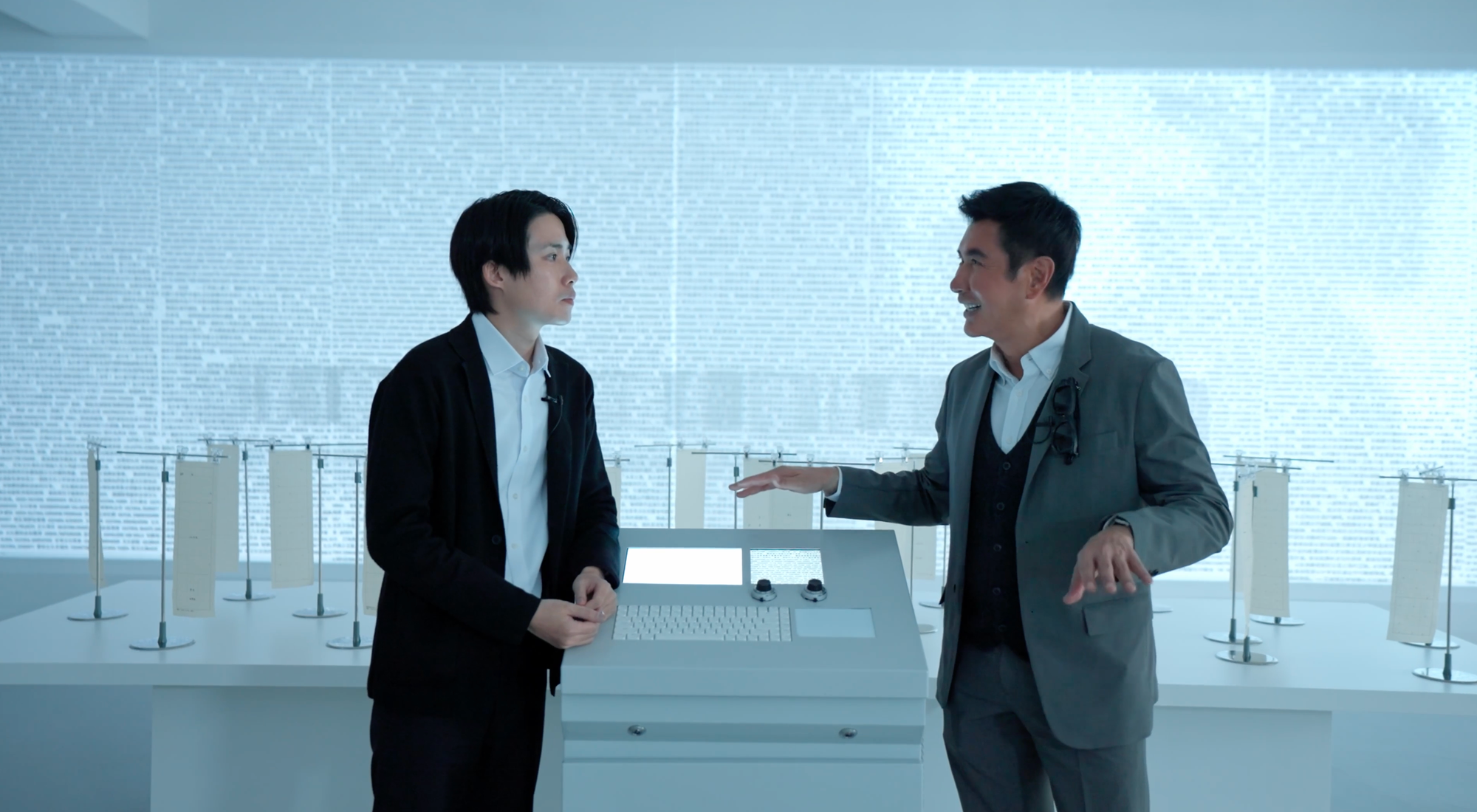
Unexpectedly, some of my most recent reflections on this came not from a boardroom, but from the studio of new media artist Lazarus Chan.
Surrounded by immersive soundscapes and generative visual systems, I watched as algorithms responded to live data, producing patterns that would never repeat in exactly the same way again. Nothing in the room was static. The work was alive, shaped by past parameters set in advance, yet open to evolution.
Standing there, I saw a metaphor for legacy. When I was younger, leadership felt synonymous with control. Stepping into serious responsibility at an early age, I believed strength meant decisiveness, clarity, and personal oversight. In high-stakes moments, that instinct serves you well. But over decades, I have learned that control is not the same as continuity.
In Lazarus’s practice, technology is not merely a tool. It is a collaborator. He designs the system carefully, encoding his intentions into its structure. Yet once activated, the work unfolds beyond his constant intervention. He trusts the framework he has built.
That struck me deeply. Many founders, particularly in Asia, build enterprises through sheer force of will. Their judgment guides every negotiation. Their presence anchors every decision. But when authority resides solely in personality rather than in principle, the organisation becomes dependent rather than resilient.
At this stage of my life, I see clearly that the real work of leadership is architectural. It is about designing systems—governance, culture, values—that can generate sound decisions even in your absence.
As a father, this lesson feels equally relevant. You do not raise children by scripting their every move. You give them values, boundaries, and a sense of responsibility. Then, gradually, you allow them to make choices you might not have made yourself. That is not a weakness. It is confidence in what you have instilled.
The same applies to business. Succession is often misunderstood as a moment: a ceremony, a signature, a change of title. In reality, it is a process of encoding philosophy into structure. If your enterprise cannot articulate how decisions are made, what risks are acceptable, and which principles are non-negotiable, then it has not been prepared to endure.
In my conversation with Lazarus, we also discussed artificial intelligence and authorship. He does not see AI as replacing human creativity. Rather, he sees it as expanding perception, revealing patterns too complex for any one individual to grasp alone. The human defines purpose; the system amplifies possibility.
There is wisdom in that balance. In my generation, experience was our greatest asset. We learned through cycles of volatility and recovery. Today’s younger leaders possess a different kind of fluency—technological, global, instinctively adaptive. Neither perspective is complete on its own. But together, within a thoughtfully designed framework, they create momentum.
As a philanthropist working across communities and cultures, I have seen that institutions endure when they are open to evolution but still are firmly anchored in values. Rigidity erodes relevance. Excessive flexibility erodes identity. The art lies in calibration.
At sixty-six, I no longer measure success by immediate expansion or short-term recognition. I measure it by whether what I have helped build can function with integrity without my direct supervision. Whether the next generation feels empowered rather than constrained. Whether innovation can occur without undermining core principles.
The visit to that generative studio reminded me that legacy is not a monument carved in stone. It is a living system. It must breathe. It must adapt. It must respond to new data, new realities, new minds.
Designing what outlives you requires humility. It requires the willingness to let go of absolute control while remaining deeply intentional about structure. It requires trusting that if you have embedded the right values, the system will hold.
Whether in business, family, philanthropy or creative work, the question remains the same: have you built something that depends on you, or something that can evolve beyond you?
At this stage of my life, I know which one truly matters.