The Secret Behind Great Interview Preparation

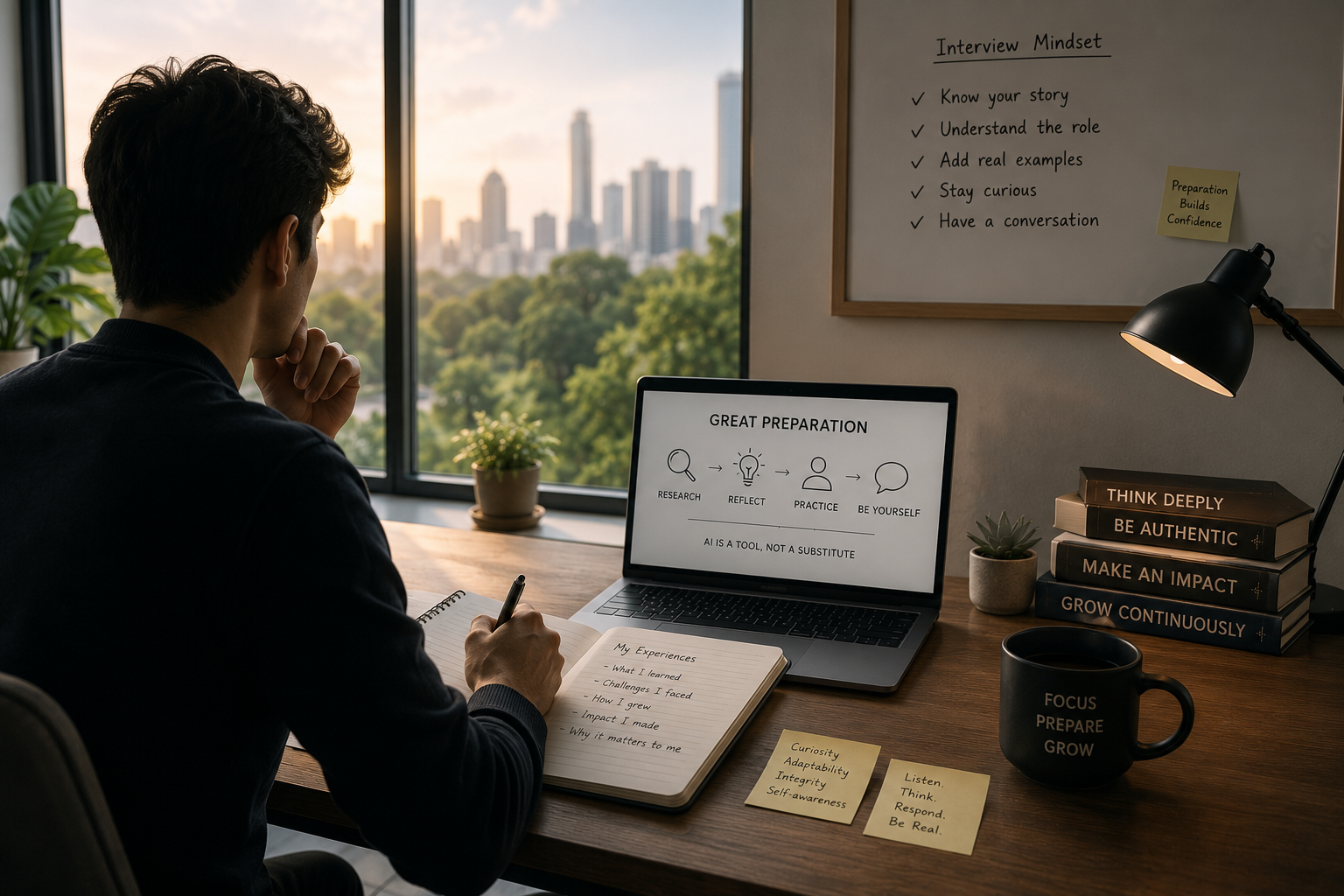
Many people assume success depends upon finding the perfect answer to predictable questions. They rehearse responses to "Tell me about yourself", prepare examples of leadership and memorise carefully constructed stories about overcoming challenges. Preparation often becomes an exercise in anticipating what another person wants to hear.
That approach has always been limited. Recent advances in artificial intelligence have simply made the limitation more obvious.
Today, almost anyone can ask AI to generate interview questions, summarise a company's history, analyse an industry, explain a job description or identify the skills an employer is likely to value. Those are genuinely useful applications of technology. Good preparation has always begun with research, and artificial intelligence has become an extraordinarily capable research assistant. Arriving at an interview without understanding the organisation or the role is no longer a reflection of limited access to information. More often, it reflects limited curiosity.
The more interesting work begins once the research is finished. Many candidates now spend hours refining answers with artificial intelligence, asking it to rewrite responses until every sentence sounds polished and persuasive. The result is often impressive on paper. During a conversation, however, something important is missing. Experienced interviewers are rarely searching for perfectly constructed answers. They are trying to understand how someone thinks, how they make decisions and how they respond when a conversation moves in an unexpected direction.
No language model can answer those questions on your behalf because they are not really questions about language. The strongest interview responses usually begin with reflection rather than technology. Why did a particular project matter to you? Which mistake changed the way you work? When have you changed your mind after listening to someone else's perspective? Which experience genuinely shaped the person you are becoming? Those answers cannot be downloaded because they are rooted in lived experience rather than information.
Artificial intelligence can certainly help organise your thoughts. Asking it to challenge your ideas, suggest follow-up questions or simulate a practice interview can be enormously valuable. Such exercises encourage deeper thinking rather than replacing it. The distinction matters because technology should strengthen our judgement, not quietly substitute for it.
The same principle extends well beyond interviews. Every generation inherits tools that transform the way people work. Calculators changed mathematics. Search engines transformed research. Artificial intelligence is reshaping knowledge work at remarkable speed. None of those technologies diminished the importance of critical thinking. If anything, they made it more valuable. When information becomes universally accessible, judgement becomes the quality that distinguishes one person from another.
Employers understand this. Technical skills remain important, but curiosity, integrity, adaptability and self-awareness have become increasingly difficult to automate. Interviews are designed to uncover those qualities because they reveal how someone is likely to contribute when circumstances become uncertain. A candidate who can recite impressive answers may perform well for a few minutes. A candidate who understands their own experiences, values and motivations leaves a far more lasting impression.
Reaching your peak has never meant becoming the person with the best rehearsed answers. Success belongs to people who understand themselves well enough to speak with clarity when no script exists. Technology can help you prepare more efficiently, broaden your perspective and expose gaps in your knowledge. No technology, however sophisticated, can replace the thoughtful work of understanding who you are, what you believe and how your experiences have shaped your judgement.
The most memorable interviews rarely feel like performances. They feel like conversations with someone who has done the quiet work of reflection before walking into the room. Artificial intelligence can help you prepare for that conversation. Only you can give it a voice worth listening to.